Ksitigarbha King Bodhisattva Statues

Ksitigarbha King Bodhisattva Statues

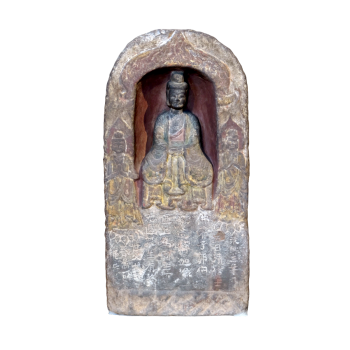
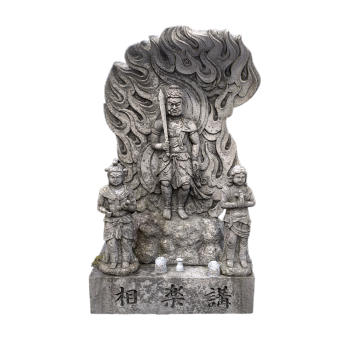
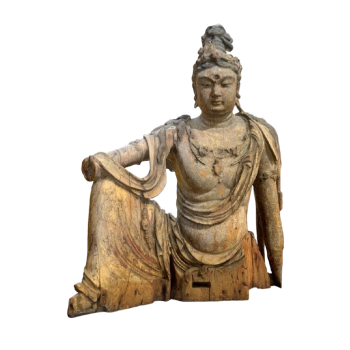
The King Bodhisattva (Kṣitigarbha Bodhisattva) is one of the four major Bodhisattvas of Chinese Buddhism. It is famous for its "great wish" ("hell is not empty, vows not to become a Buddha"), and is mainly responsible for saving all living beings in hell.
Ksitigarbha Bodhisattva

Ksitigarbha Bodhisattva

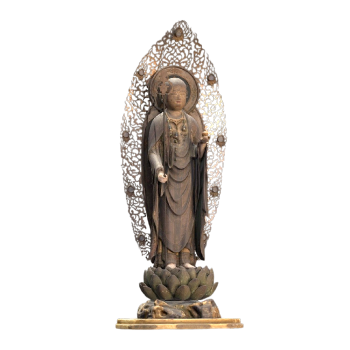
Ksitigarbha Bodhisattva is one of the four Bodhisattvas in Mahayana Buddhism. He is famous for his "great wish". His famous oath is "hell is not empty, and he will not become a Buddha". He is mainly responsible for saving six sentient beings, especially those suffering in hell, in the Buddha-free world after the Nirvana of Shakyamuni Buddha and before the birth of Maitreya Buddha. Ksitigarbha Bodhisattva usually appears in the image of a monk. This is the difference between him and other major Bodhisattvas (such as Guanyin, Manjusri, and Samurian) in the appearance of heaven and man (wearing wreaths and crowns).
Gold Paneled Pendant

Gold Paneled Pendant

Dendra Zodiac relief (3D printable)

Dendra Zodiac relief (3D printable)

The "relief of the Zodiac in the Louvre" is an important relic of astronomical art in the late ancient Egypt (Ptolemaic period, about the 1st century BC-the 1st century AD). It was originally an "astronomical ceiling" decoration of the Temple of Dendra (Temple of Dendera) in Egypt. This group of reliefs is famous for accurate astronomical observation and mysterious religious symbols. It is a typical representative of the fusion of "astronomical calendar-theocracy" in ancient Egypt. It is now hidden in the "Egyptian Art Department" of the Louvre (Musée du Louvre) in Paris, France ".
Amenemhat III Pyramid spire (3D printable)

Amenemhat III Pyramid spire (3D printable)

The Black Pyramid was the first true pyramid built by Pharaoh Amenemkht III of the Twelfth Dynasty of Egypt between 2055-1650 BC. The building is located in the heart of the desert in the Dahshur region. As an important part of the large royal cemetery, its original height is about 75 meters. The ground floor has an entrance to the atrium and the funeral temple. Although it belongs to the true pyramid type, it has now collapsed due to structural problems, leaving only the core of the black mound, which forms a prominent visual feature in the golden desert.
Song Dynasty Emperor's Tombs

Song Dynasty Emperor's Tombs

Holy Bone Box of Qingshan Temple in Jining City

Holy Bone Box of Qingshan Temple in Jining City

Qingshan Temple is Huiji Gong Temple, also known as Jiao Wang Temple. It is located in Qingshan Village, Zhifang Town, Jiaxiang County, Jining City, Shandong Province. It is an ancestral temple dedicated to the king of Jiao State in the Western Zhou Dynasty. It was later expanded into a temple integrating Buddhism and Taoism. It was built at the end of the Eastern Han Dynasty. It was rebuilt and expanded many times in the Song, Yuan, Ming, and Qing dynasties. The existing buildings were basically built in the Qing Dynasty and the Republic of China. Because the temple is located on the side of the green hills, the locals call it Qingshan Temple.
El Canio, Panama Whalebone Crocodile Pendant

El Canio, Panama Whalebone Crocodile Pendant

"Panamanian El Canio Whalebone Crocodile Pendant" is a traditional handicraft in El Caño (El Caño, located near the Panama Canal Zone) in central Panama. It uses whale bone as material and carves crocodile shapes. It is a typical representative of the integration of Panamanian aboriginal culture and natural ecology. It is not only a daily accessory for local residents, but also an important material symbol of Panama's "Ocean-Jungle" culture, carrying the awe of nature and the memory of ancestors.
El Canio Shark Tooth Perforated Pendant

El Canio Shark Tooth Perforated Pendant

"El Canio Shark Tooth Perforated Pendant" is a representative handicraft of the indigenous culture of the El Canio region (El Caño) on the Caribbean coast of Panama. It uses shark teeth as the core material and is perforated by traditional craftsmanship to make pendants. It is not only the material carrier of Panama's "marine culture", but also the spiritual symbol of the symbiosis between the aborigines and nature, carrying the historical memory and cultural identity of the local tribes.
Gold-inlaid pendant of the Jinba sub-culture

Gold-inlaid pendant of the Jinba sub-culture

Kimba culture (Quimbaya culture) is one of the most representative ancient civilizations in western Colombia during the pre-Columbian period (about 1000 BC-16th century AD). It is famous for its highly developed metallurgical technology, exquisite artistic achievements and unique religious beliefs. Its name comes from the "Cementerio de los Quimbayas" (Cemetery of Kimbaya) in (Cauca), Colombia, where 19th century archaeologists discovered a large number of well-preserved gold artifacts and tombs, which for the first time systematically revealed the glory of this civilization.
Meleha Neolithic Flint Arrow

Meleha Neolithic Flint Arrow

"Meliha Neolithic Flint Arrow" is a typical Neolithic (about 6000-3000 BC) stone weapon unearthed at the Mleiha Archaeological Site in central Oman. It is made of flint (Flint) and is a key tool for early human transition from gathering and hunting to agricultural settlement. It is also an important physical evidence for studying early technology, economy and society in the Arabian Peninsula.
Middle Bronze Age flanged flat axe

Middle Bronze Age flanged flat axe

"Flanged flat axe in the middle of the Bronze Age" is a metal tool/weapon popular in many parts of Eurasia in the middle of the Bronze Age (about 2000-1600 BC, depending on the region). Its core feature is that the axe head has a flange (Flange) (strip structure with the edge of the blade protruding outward) and a flat blade body (Palstave) (the blade is wide and thin, shovel-shaped or trapezoidal). It is a typical representative of the transition from stone tools to metal tools after the maturity of bronze smelting technology. It is not only a practical tool, but also a material witness of the complexity of early society.
Late Bronze Age with rings and axes

Late Bronze Age with rings and axes

The late Bronze Age was a critical stage in the transition from stone tools to metal tools. With the maturity of bronze (copper-tin alloy) smelting technology, humans broke through the limitations of early stone tools and began to mass produce more durable and efficient metal tools. The emergence of the axe (Socketed Axehead) was an important technological breakthrough in this period-compared with the earlier "Flat Axe" (Flat Axe, which is easy to loosen by binding and fixing the wooden handle), its mortise hole design (inserting the wooden handle into the conical or cylindrical hole of the axe head, and fixing it by the close fit of metal and wood) greatly improved the stability of the tool.
Golden Horn of Kimbayah

Golden Horn of Kimbayah

The "Golden Horn of Golden Baya Culture" is one of the most mysterious golden ceremonial artifacts of the ancient Colombian Golden Baya Culture (Quimbaya culture, about 1000 BC-16th century AD). It is famous for its unique shape, exquisite craftsmanship and profound religious connotation. It is not only the "sound medium" in the sacrificial ceremony of the Kimbayas, but also a vivid witness of the "golden worship" and "natural belief" of the South American civilization in the pre-Columbian period. It is called the "golden totem that can make a sound".
Golden incense burner of Jinba culture

Golden incense burner of Jinba culture

"Golden incense burner of Jinbaya culture" is one of the most representative golden religious artifacts of ancient Jinbaya culture in Colombia. It is famous for its exquisite craftsmanship, mysterious decoration and profound religious connotation. The Kimba culture is mainly distributed in the western Andes of Colombia and is one of the earliest civilizations in South America to master complex metallurgical technology. Its name comes from the 19th century Colombian archaeologist's discovery of the "Kimbaya Cemetery", a culture known for its highly developed gold casting, pottery making and agriculture.
Golden Earrings of Kimbaya Civilization

Golden Earrings of Kimbaya Civilization

"Jinbayan civilization earrings" is one of the most representative gold jewelry of ancient Jinbayan civilization in Colombia (Quimbaya culture, about 1000 BC-16th century AD). It is famous for its exquisite craftsmanship, complex decoration and profound cultural connotation. The Kimba culture is mainly distributed in the western Andes of Colombia, and its name is derived from the discovery of the "Kimba Cemetery" by Colombian archaeologists in the 19th century. The culture is known for its highly developed metallurgical technology, complex social hierarchy and unique religious system, and is considered to be the most advanced civilization in pre-Columbian South America.
Marseille culture bone mortar

Marseille culture bone mortar

The "Masai culture mortar" is a common traditional tool in East Africa and is closely related to the nomadic life, dietary traditions and cultural beliefs of the Maasai. The Masai people are the main indigenous people in Kenya and Tanzania. They take animal husbandry (cattle and sheep) as the core economic model. Their culture emphasizes the dependence on nature and the inheritance of traditional skills. As an indispensable tool in Masai's daily life, bone mortar is not only a practical "grinder", but also a cultural symbol carrying national memory.
Bilbao Civilian Resistance Auxiliary Volunteer Beret

Bilbao Civilian Resistance Auxiliary Volunteer Beret

As an industrial and port town in the Basque Country, Bilbao is an important stronghold of the Republican government (against the Franco dictatorship). In the early days of the war, the Franco forces blockaded Bilbao, and the city faced shortages and medical collapse. The local people spontaneously set up "auxiliary volunteer" groups, wearing berets with unified logo to participate in the rescue, which became one of the symbols of "civilian resistance" in the war.
Attica red painted jug unearthed in Camarina, Sicily

Attica red painted jug unearthed in Camarina, Sicily

"Attic red-figure hydra" (Attic red-figure hydra) is a classic red-painted pottery produced in the ancient Greek Attica region (centered on Athens), while "Sicily" (Camarina, Sicily) was unearthed in an ancient Greek colony in southern Sicily, Italy.
Arab Antique Aden Dagger

Arab Antique Aden Dagger

19th Century Qing Dynasty Cultural Relics Guan Dao

19th Century Qing Dynasty Cultural Relics Guan Dao

Nepal Cultural Heritage Garuda Stone Carvings

Nepal Cultural Heritage Garuda Stone Carvings

Garuda is a bird (usually an eagle) in Hindu mythology, a mount (vahana) of the god Vishnu. Garuda unfolded in two forms. One is an animal form (such as a huge bird with half-spread wings), and the other is an anthropomorphic form (such as a human form with wings and some bird features).
Iranian Minai Pottery Depicting Sitting King's Bowl

Iranian Minai Pottery Depicting Sitting King's Bowl

Mina' I ware is a very famous ceramic craft in Iran in the 12th century, famous for its exquisite decoration and rich painted patterns. This pottery combines the unique aesthetic of the Islamic world with superb craftsmanship and is used to show social status or religious stories. Minay pottery depicting the bowl of a seated king, 12th century AD, currently in the collection of the Minneapolis Institute of Art.
Indian 13th Century Sculpture Krishna Bronze Statue

Indian 13th Century Sculpture Krishna Bronze Statue

This is a bronze statue of Krishna from the southern Indian state of Tamil Nadu. This statue reflects the image of Krishna, one of the incarnations of the Hindu god Vishnu. Krishna is not only a deeply worshipped god in Hinduism, but also an important role in the epic Mahabharata. This sculpture has been identified as a cultural relic from the 13th to 14th centuries and is currently preserved in the Museum of World Cultures and Peoples in Barcelona, Spain. It is not only a symbol of Indian culture, but also an important heritage of cross-cultural communication.
1 2 3 4 5 6 7 8 9 ... 15 Next